Pool Start-Up After Resurfacing in New Braunfels, TX
New Braunfels Quality Pool Resurfacing handles the pool start-up after resurfacing in New Braunfels, Texas. That means the first 28 days of brushing, testing and balancing the water once a new cement finish is filled. In those 28 days a new finish is especially prone to staining, scaling and discoloration, the National Plasterers Council says.
The free estimate covers start-up too; call or use the form. We'll talk through whose start-up your finish calls for, what the fill water brings with it, and the city's rules on topping up and draining.
Call or request a free estimate any time, 24/7
No charge · answered 24/7
Get free estimates
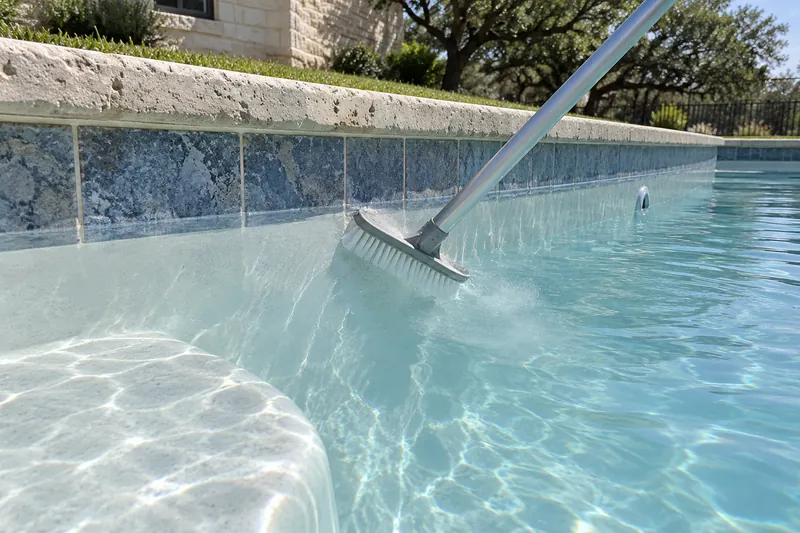
The National Plasterers Council's 28-day pool start-up
The council publishes a start-up card, free to pool owners, with a day-by-day routine. It calls the steps sound trade practice but advisory, and says parts may need changing for unusual fill water. Makers of proprietary finishes publish their own fill and start-up instructions, and those come first for their finishes.
Before and during the pool fill
A clean cloth on the end of the hose, laid at the deepest point, keeps the incoming water from damaging the surface. If a water truck brings the water, the council wants at least 24 inches in the deep end first, as a cushion. Keep sprinklers and rain runoff off the finish until the pool is full, and keep people and pets out of it. A fill can take 18 to 36 hours, one finish maker says.
Day 1: test and balance the fill water
Test the water for pH, total alkalinity and calcium hardness. Bring high alkalinity down to 80 to 100 parts per million (ppm) with pre-diluted muriatic acid, or raise low alkalinity to 80 ppm with baking soda (sodium bicarbonate). Then lower the pH to 7.2 to 7.6. Brush every part of the surface twice a day or more. The pump and filter run nonstop for seven days, or until the plaster dust is gone and the water is clear, and never less than 72 hours. No chlorine goes in for 48 hours.
Day 2: raise the calcium
With alkalinity and pH in range, bring calcium hardness up to 100 to 150 ppm with calcium chloride. It goes in 10 lb at a time, several hours apart, and never together with baking soda.
Day 3: add chlorine
Bring the chlorine to 1.5 to 3.0 ppm with pre-diluted or liquid chlorine. In a saltwater pool, hold off on salt for the first 30 days.
Day 4 onward: calcium and stabilizer
If needed, raise calcium hardness slowly to at least 200 ppm. Start bringing the stabilizer (cyanuric acid) to 30 to 50 ppm, added through the skimmer. Concentrated cyanuric acid can discolor tinted finishes.
Day 7: clear the last dust
Any plaster dust still in the pool comes out with a brush vacuum. After that, with a good cleaning system, brushing can be kept to visible debris or to times when chemicals go in.
Days 8 to 28: keep the water balanced
No wheeled vacuums or wheeled cleaners until after day 28, though brush vacuums are fine. The council's filling tips also keep the heater off for those 28 days. By then about 85% of the cement's curing reaction is done, the council says, and the rest goes on for years.
The plastering that comes before all this is on our pool replastering page.
Call or request a free estimate any time, 24/7.
(830) 302-4112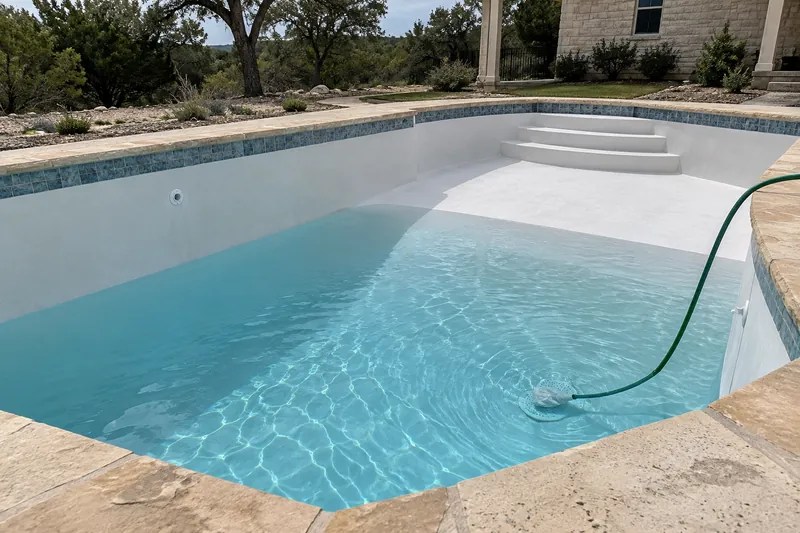
Traditional vs bicarb start-up
The traditional start-up
The routine above is the one the industry calls the traditional start-up, and it is the one the National Plasterers Council publishes. The council says other start-up methods are known to give similar good results. In a 2010 trade report, it agreed that acid etches plaster and that bicarb may protect it. It still backed the traditional method because it's simple enough for anyone, homeowners included, to follow. That method is also printed in industry training manuals.
The bicarb start-up, from its promoters
The bicarb method comes from its promoters, a pool-chemistry consulting group, not from the council or any official body. They add baking soda to the fill water before it enters the pool. The aim is to turn the calcium hydroxide at the surface (a soft compound that forms as cement cures) into tougher calcium carbonate. The difference they report is virtually no plaster dust. They also say an acid start-up dissolves the plaster dust but etches the whole surface with it, leaving it rougher and more porous.
A study the promoters ran, covered in the same 2010 report, rated bicarb ideal, the council's routine a close second and an acid start-up last.
Which start-up your finish needs
Start with the maker of your finish. Some adopt the council's routine outright: one finish maker tells owners of every product it makes to follow it, and another reprints it in its catalog. PebbleTec's maker sets its own range for the first 28 days and says it isn't meant for traditional plaster. It calls for pH 7.0 to 7.4, alkalinity 80 to 90 ppm and calcium hardness 200 to 250 ppm. Our pebble pool finishes page lists PebbleTec's care rules, and our quartz pool finishes page lists Diamond Brite's.
At the free estimate, New Braunfels Quality Pool Resurfacing talks through which routine your finish's maker requires.
Call or request a free estimate any time, 24/7.
(830) 302-4112Pool start-up water targets and New Braunfels water
After day 28, the council's card moves to long-term targets. The main one is the saturation index, a single number worked out from pH, alkalinity, calcium hardness, temperature and dissolved solids. A negative reading means the water is pulling calcium out of the finish; a positive one means it's laying scale down. The card says to hold it between 0.0 and +0.3, especially in the first six months after start-up. At 100 ppm or more, cyanuric acid may do lasting damage to the surface, it warns.
What New Braunfels tap water brings
State records of the city utility's treated water show total alkalinity of 231 mg/L on July 16, 2025 and 150 mg/L on January 14, 2026. The utility's own report treats mg/L and ppm as the same unit, so both readings sit above the card's Day 1 alkalinity target of 80 to 100 ppm. Test the fill water itself, as the council advises: pH, alkalinity, calcium hardness and metals. Don't fill with softened or reverse-osmosis water; the council says soft water damages cement finishes. Our guide to hard water and pool surfaces covers the local samples in full.
Topping up and draining during start-up
A new finish should stay fully under water, the council says, apart from limited servicing or repair. During watering hours, the city's drought plan lets you add water up to the pool's maintenance level, the level the filter needs. Year round, those hours leave out 10 a.m. to 8 p.m. Neither the city nor the utility has a rule written for start-up water use. A partial drain therefore follows the general rule, which allows draining only for rain overflow, hazardous pool parts and leak repairs.
- Free chlorine
- 1–3 ppm
- pH
- 7.2–7.6
- Carbonate alkalinity
- 80–120 ppm
- Calcium hardness
- 200–400 ppm
- Stabilizer (cyanuric acid)
- 30–50 ppm
- Total dissolved solids
- 300–1,800 ppm
National Plasterers Council start-up card, revised 2021. Advisory; a finish maker's own range comes first.
Call or request a free estimate any time, 24/7.
(830) 302-4112Pool start-up questions
How much does a pool startup cost?
For the chemicals alone, 2026 national figures budget roughly $150 to $300. A professional start-up on its own has no published price. Ask about it in the free estimate from New Braunfels Quality Pool Resurfacing.
What chemicals do you put in a pool when you first fill it?
On the council's card: pre-diluted muriatic acid to bring down high alkalinity and pH, or baking soda if alkalinity is low. Then calcium chloride from day 2, chlorine from day 3 and cyanuric acid from day 4. A sequestering agent, which holds metals in the water, is optional, though many recommend one. Some finish makers set different products and timings.
What do I need to start up my pool for the first time?
A pool brush, a brush vacuum, a way to test the water daily, the chemicals above, and a pump and filter that can run nonstop through the first week. The council's start-up card is free to pool owners. If someone else will handle it, the council also certifies start-up technicians through a 3-hour online class.
Do I add muriatic acid or shock first?
Acid comes first on the council's card. Day 1 adjusts alkalinity and pH with diluted muriatic acid, chlorine stays out for 48 hours, and it goes in on day 3. PebbleTec's maker likewise says not to chlorinate until pH and carbonate alkalinity are in range.
Who does the start-up, the contractor or the owner?
Normally the contractor. One finish maker says start-up is the remodeling company's or builder's responsibility, and that they need to follow the council's guidelines to keep the finish warranty. One contractor's New Braunfels price page lists start-up chemistry as the last step of the job, right after the fill.
Plan the start-up for your new finish
Calls and estimate requests about start-up after resurfacing reach New Braunfels Quality Pool Resurfacing any time, day or night, from New Braunfels and the towns around it. Tell us which finish is going in.