Fiberglass Pool Resurfacing and Repair in New Braunfels, TX
New Braunfels Quality Pool Resurfacing handles fiberglass pool resurfacing and repair in New Braunfels, Texas. The inside of a fiberglass pool is a layer of colored resin called gelcoat, applied at the factory. When it chalks, cracks or blisters, the damage can be repaired in spots, or the whole surface covered with a coating made for pools already in the ground.
Fiberglass repair estimates are free; call at any hour or send the form. Before any water comes out, we'll go over what your pool maker's warranty says about draining and the city's drought rules. We'll also weigh a spot repair against a full coating for the damage you have.
Call or request a free estimate any time, 24/7
No charge · answered 24/7
Get free estimates
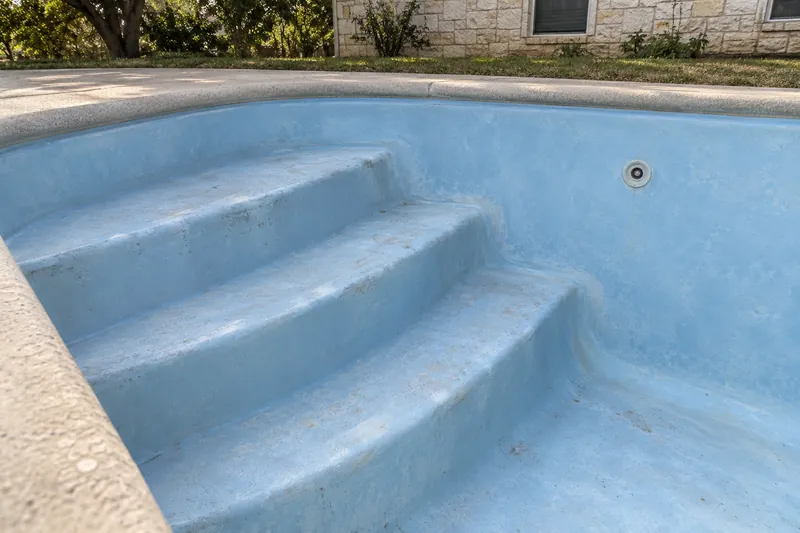
Fiberglass pool repair: how gelcoat wears
Fading, chalking and scale
Some fading is expected. A fiberglass pool sits in the sun, and its color fades evenly and gradually, says River Pools, a fiberglass pool maker. Another maker warns that the wrong water chemistry can discolor, chalk, fade, etch or scale gelcoat, and may void the warranty. Its rule of thumb: scale forms whenever the pH is above 7.4 and calcium hardness is above 120 parts per million. It says there's rarely, if ever, a reason to add calcium to a fiberglass pool, and that concrete-pool standards don't carry over. Salt chlorine generators tend to push the pH up, so they need close watching.
Hard water is part of life here. New Braunfels Utilities says its groundwater sources carry extra calcium and magnesium, and that hardness shifts with location, source and season. Too little calcium has its own cost, though: in fiberglass and vinyl pools, soft water can attack metal fittings and heater parts, the plastering industry notes.
Hairline and spider cracks
Hairline cracks in gelcoat aren't unusual, says Latham, a pool maker, whose gelcoat is seven to eight times thicker than a normal coat of paint. Spider cracks form when pressure on the shell is more than the gelcoat can flex with. They're typically cosmetic, not structural, another maker says. Matching a repair is easier on a single-layer solid color than on a multi-layer metallic or flake finish.
Osmotic blisters
Blisters start inside the surface. Water passes through the gelcoat, meets contaminants behind it and forms larger molecules that can't get back out. That outward pressure raises a blister and can part the gelcoat from the layer beneath, the same maker explains. Gelcoat sprayed too thin can lead to blisters, and too thick, to cracks. Because blisters are a surface problem, that maker says a good warranty must name osmotic blisters, not just the structure.
Call or request a free estimate any time, 24/7.
(830) 302-4112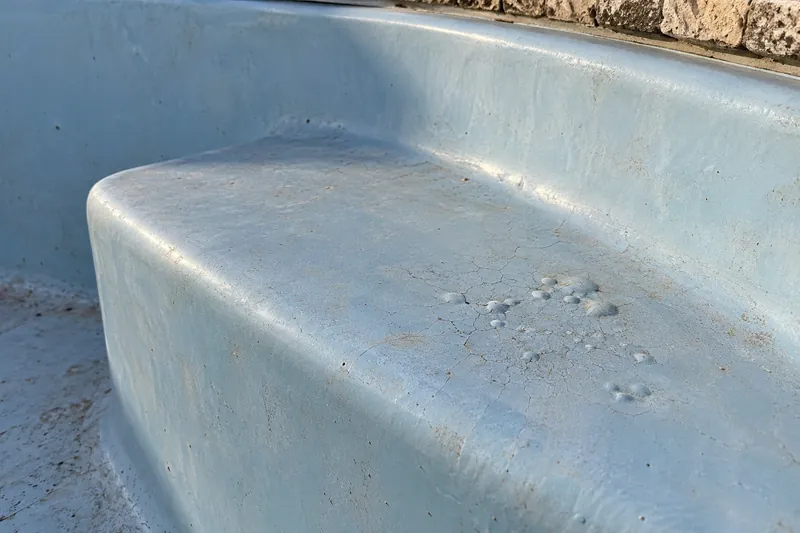
Resurfacing a fiberglass pool in the ground
Why gelcoat isn't resprayed at home
Gelcoat goes on in a factory for good reasons. It's sprayed in three passes to a total of 25 to 30 mils (thousandths of an inch), ideally at 77°F. It has to cure at a steady temperature that would be nearly impossible to hold outdoors, and moisture at any stage can stop a full cure. That's why an installed pool doesn't get new gelcoat sprayed in the backyard, the same fiberglass pool maker says. New high-gloss and multi-dimensional gelcoats can only go into new factory pools, a coating maker adds.
Coatings made for installed pools
Instead, the surface gets a coating built for in-ground pools. The fiberglass pool maker points to ecoFINISH, a chemical-resistant coating that bonds to concrete or fiberglass and goes on with the pool in place. Its maker claims its fiberglass coating won't blister the way gelcoats and paints can, flexes with the shell, comes in any color and lets the pool be filled right away. Re-gelcoating, by contrast, limits the color to light shades, it says.
Epoxy paint on fiberglass
Paint is the lower-cost route. Three pool paint makers all specify epoxy for fiberglass shells. One maker's prep sands the gelcoat in straight lines with coarse sandpaper, with no acid etch as it would use on plaster. Two makers' water-based acrylics aren't meant for fiberglass at all. Our pool painting page covers paint types, prep and cure times.
In northern Wilson County, on the south bank of Cibolo Creek, New Braunfels Quality Pool Resurfacing also handles fiberglass pool resurfacing in La Vernia.
Call or request a free estimate any time, 24/7.
(830) 302-4112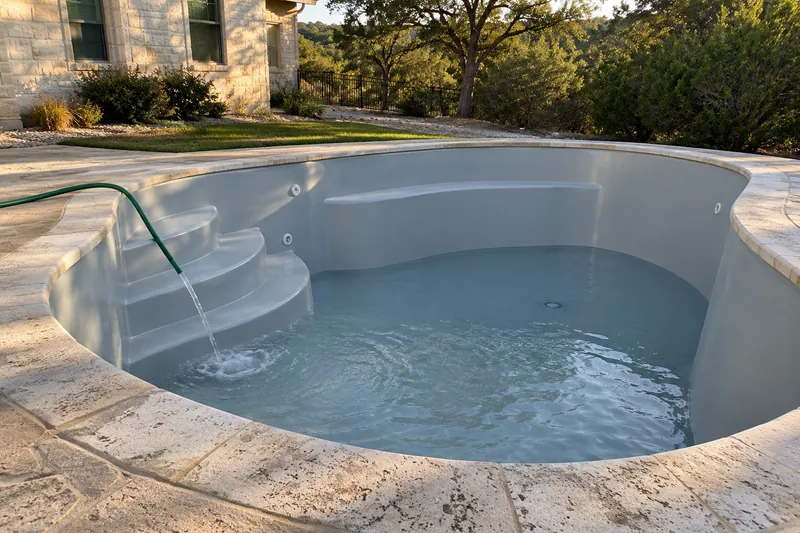
Draining a fiberglass pool: the makers' rules and the city's
The makers' rules come first, because draining can void a fiberglass pool's warranty. Here is what they say:
- The maker quoted above on blisters says that for most makers, an authorized dealer must drain the pool or the warranty may be void. Its method needs dry weather, groundwater pumped away and, typically, three braces 18 to 24 inches down the side walls.
- Another maker's manual says draining voids its warranty, and a shell drained without first relieving the groundwater pressure will buckle and crack.
- A third forbids draining, or even lowering the water below the skimmer, without its prior authorization. Draining can cause structural damage, blisters or gelcoat cracks, it says.
- A fourth maker's lifetime warranty covers the gelcoat against osmotic blisters for 10 years, and draining the pool voids it.
Day to day, the first maker on that list recommends keeping the water a third to halfway up the skimmer and never draining a fiberglass pool. So check your own pool's warranty, and who its maker allows to drain it, before any water comes out.
Groundwater, clay and the drought plan
Clay holds water around a pool longest and sandy soil the least, the same maker notes, and that water pushes up on an empty shell. East of the Balcones Escarpment, which crosses eastern Comal County, the Blackland Prairie soils are mainly deep clays. For Houston Black and similar clays, the federal soil survey lists very slow permeability among the limits. Vinyl liners can bubble and float under the same uplift, which our pool liner replacement page explains.
The city's drought plan adds its own limits. Since October 1, 2026, it has allowed a pool to be drained only onto ground that absorbs the water. The drain must also be to lower rainwater, fix a part that has become hazardous, or repair a leak. Ask New Braunfels Utilities whether your job qualifies before setting a date.
Call or request a free estimate any time, 24/7.
(830) 302-4112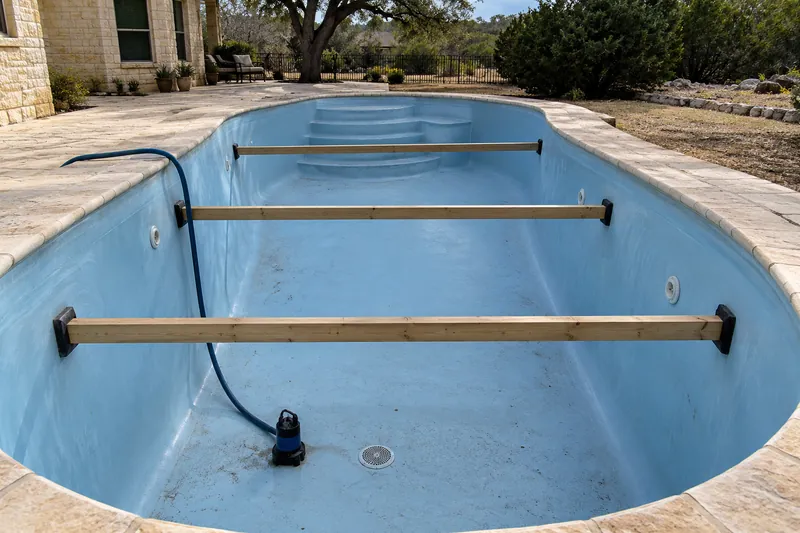
Fiberglass resurfacing and repair costs
No New Braunfels or San Antonio-area price list covers fiberglass work, so national figures are the guide. National averages for 2025 put a full fiberglass resurfacing at $7,000 to $15,000, depending on size, shape and finish. A 2026 national estimate puts a fiberglass resurface at around $6,000 to $8,000 for parts and labor.
Treat them as published averages; none is a price from New Braunfels Quality Pool Resurfacing. Draining, refilling and chemicals can come on top, so ask what an estimate includes. Ours is free.
- Gelcoat repair (dings, scratches, cracks)
- $300–$400
- Full fiberglass resurfacing
- $7,000–$15,000
- Sprayed thermo-polymer coating, medium pool
- $10,000–$15,000
National averages, 2025. Not a quote.
Call or request a free estimate any time, 24/7.
(830) 302-4112Fiberglass pool repair questions owners ask
Can a fiberglass pool be resurfaced?
Yes, though not with new gelcoat. Gelcoat needs a factory's controlled conditions to cure properly, so a pool in the ground gets a coating made for installed pools, or an epoxy pool paint, instead. Ask whether your pool maker's warranty allows the pool to be drained for the work.
Can fiberglass pools be repaired?
Often, yes, in spots. Hairline and spider cracks are usually cosmetic, and dings, scratches and cracks can be patched with a gelcoat repair. Whitening from high pH can often be corrected with chemical treatment if it's caught within about one to three months, one maker says. Left longer than three months, it can become severe and may need professional repair, and that maker doesn't treat it as a manufacturing defect.
How much does it cost to repair a fiberglass pool?
On 2025 national averages, a gel coat repair costs $300 to $400. If repainting is needed too, about $800 more may be charged, and a complete resurfacing runs $6,500, with draining, refilling and chemicals on top. No local price list covers fiberglass repair, so these national figures are the best guide.
What happens to a fiberglass pool after 25 years?
The surface may be due for refinishing. On River Pools' figures, most fiberglass pools reach at least 20 or 30 years before they need it. A coating maker puts the first signs of wear earlier, at 10 to 15 years of regular use, as the gelcoat turns chalky, discolored and rough. The shell is a separate matter: one maker's lifetime warranty covers the structure against leaks from structural failure for as long as the original buyer owns the pool.
How much does it cost to recoat a fiberglass pool?
It depends on the coating. For paint, a 2026 national estimate puts epoxy at around $100 to $200 a gallon, or $1,500 for a full application. A sprayed thermo-polymer coating costs $10,000 to $15,000 for a medium-sized pool on 2025 national averages. Paint makers specify epoxy for fiberglass, and the gelcoat is sanded first rather than acid etched.
Get a free estimate for fiberglass pool repair
Calls and estimate requests about fiberglass pools reach New Braunfels Quality Pool Resurfacing 24/7, from New Braunfels and nearby towns. Tell us the pool's maker and age, and what the surface looks like.