Pool Replastering and Plaster Repair in New Braunfels, TX
New Braunfels Quality Pool Resurfacing handles pool replastering and plaster repair in New Braunfels, Texas. That runs from patching hollow or cracked spots to taking off a tired white or colored finish and plastering the pool again. Standard white plaster is a simple mix of white cement, crushed white marble and water, and the National Plasterers Council calls it the most affordable pool finish on the market.
Estimates for replastering and plaster repair are free, by phone around the clock or through the form. We'll go over whether the plaster can be patched or should be replaced, white or colored plaster, and the city's drain rules.
Call or request a free estimate any time, 24/7
No charge · answered 24/7
Get free estimates
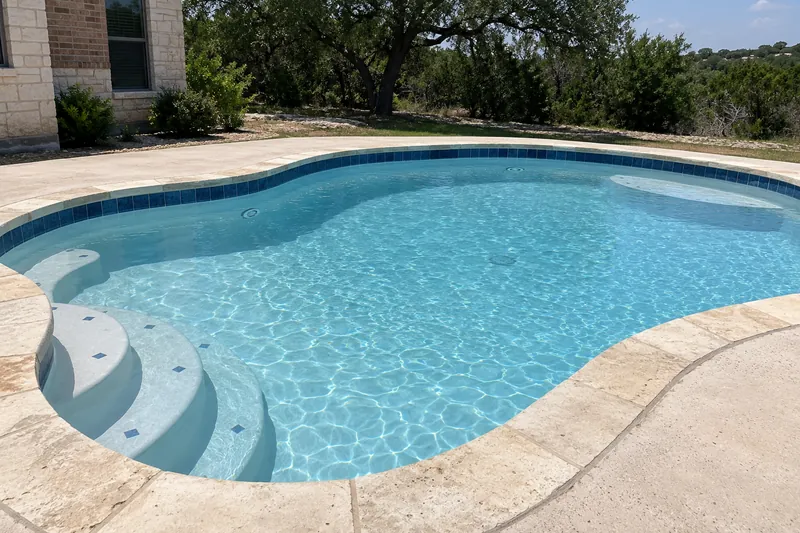
Signs your pool plaster needs repair or replastering
White plaster is a fairly soft finish, more affected by water chemistry than newer products, the National Plasterers Council says. It changes over its life. Mild signs are slight shading or scaling. Worse ones are staining, etching (rough, eaten-away spots), cracking, or the plaster coming loose. Water low in calcium, pH or alkalinity, which the industry calls aggressive water, dissolves the surface. The damage often shows first as small etched spots around the marble grains and the tile. If the water stays aggressive for long, it can badly shorten a finish's life.
Patch the plaster or replaster the pool?
The council's test is simple. Resurfacing becomes necessary when cracks and wear can no longer be patched or repaired, or when the pool no longer looks acceptable. Limited damage can often be repaired, as the questions below explain. Cracks through the shell are a different job. Without draining the pool and cutting out a sample, it's virtually impossible to tell a shrinkage crack from a structural one, a finish maker says. Our pool crack repair page covers structural cracks.
Kyle's 2025 water report puts hardness at 275 to 295 mg/L, very hard on the city's own scale, and New Braunfels Quality Pool Resurfacing offers pool replastering in Kyle.
Call or request a free estimate any time, 24/7.
(830) 302-4112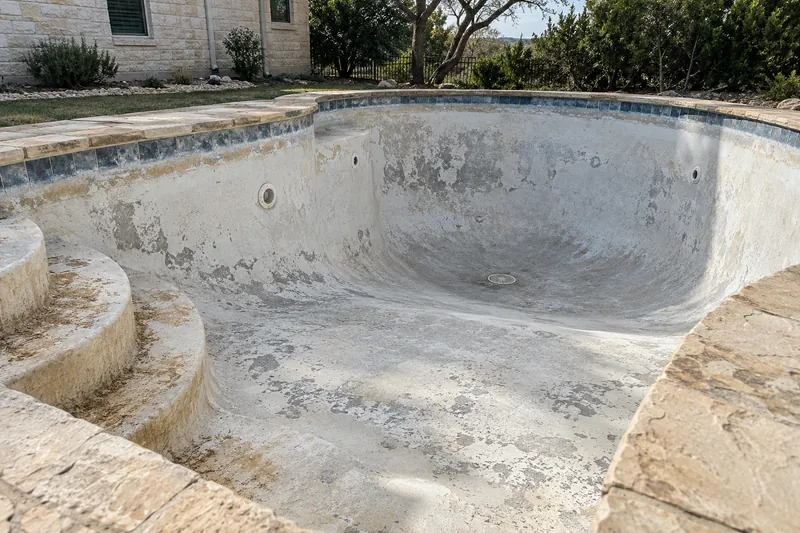
Draining a pool to replaster in New Braunfels
New plaster goes onto an empty shell, and it cures under water: the pool is filled once the surface is hard enough. So a replaster starts with a drain.
What the drought plan allows
The city's amended drought plan took effect on October 1, 2026. Since then its pool rules have applied in every month, whatever the drought stage. The water may go only onto ground that soaks it up, or onto a deck that sends it straight to such ground. And a drain is allowed only when:
- rain has raised the water above its normal (maintenance) level;
- a pool part has become hazardous and needs repair, maintenance or replacement; or
- the pool has a leak to repair.
Pool water can't be drained into a street, alley, gutter, ditch or storm drain, and letting it leave the property counts as water waste. The city's sewer code also keeps pool water out of the sanitary sewer unless New Braunfels Utilities approves it first.
The plan doesn't mention replastering, and no official guidance says whether draining to replaster counts. Don't assume either way: ask the utility before the pool is emptied. Where a water rule creates a hardship, the owner can write to the utility's Conservation Coordinator to ask for a variance, an exception to the rule. The utility reviews requests within 30 days. New Braunfels Quality Pool Resurfacing goes over the drain question at the free estimate, before any date is set.
Clay soil and groundwater
Any time a pool is drained, there's a risk of damaging the finish, the National Plasterers Council says. A pool maker warns that groundwater pressure can push on a shell left with too little water inside, until it bulges, cracks or even floats. Clay holds water around a pool longer than sandy soil does. That matters here. The Balcones Escarpment runs through eastern Comal County, and on its Blackland Prairie side the soils are mainly deep clays. Those clays swell when wet and shrink and crack as they dry, the federal soil survey says.
Call or request a free estimate any time, 24/7.
(830) 302-4112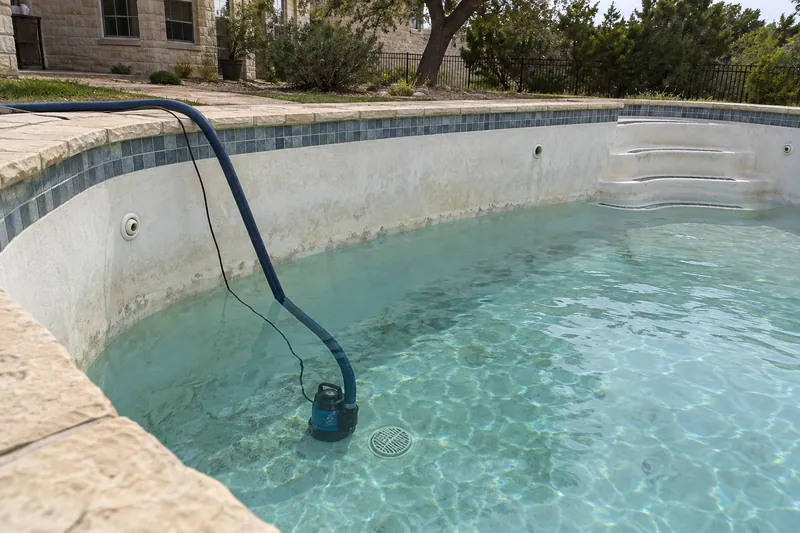
Pool plastering, step by step
Prepare the pool shell
First, any water seeping in through the shell is stopped. One finish maker's prep then cuts the old plaster back 2 inches below the tile line, and around fittings, 3/8 inch deep.
Bond coat or chip-out
Old plaster that stays gets a bond coat first, a layer that helps the new plaster grip. Where the old finish is chipped or sandblasted off, that maker says its bond coat may not be needed.
Apply the new plaster
The National Plasterers Council calls for an average thickness of at least 3/8 inch and no more than 3/4 inch. The coat is leveled by hand, so some variation in smoothness and color is normal.
Plaster around the summer heat
On average, 116.8 days a year here reach 90°F or more. No standard limits the air temperature for plastering, but heat, dry air and wind make plaster set faster and crack more as it shrinks. The council's advice: wet the shell first and start earlier in the morning.
Fill the new plaster without stopping
The fill runs nonstop and fast to the middle of the skimmer, with a clean cloth over the hose end at the deepest point. A stop can leave a discolored ring. Don't use softened or reverse-osmosis water; a home softener can be bypassed for the fill.
Start up the new plaster
The industry start-up runs 28 days. It calls for brushing the whole surface at least twice a day, and running the pump nonstop for seven days or until the water clears (72 hours at least). No chlorine for 48 hours, and no salt for 30 days.
The 2021 International Swimming Pool and Spa Code is New Braunfels' pool code, and it requires plastering to follow the national standard for plastering pools and spas. The standard's latest edition came out in April 2025. The code applies it to built-in concrete spas too, which is where spa resurfacing comes in. Our pool start-up page covers the first 28 days in full.
Call or request a free estimate any time, 24/7.
(830) 302-4112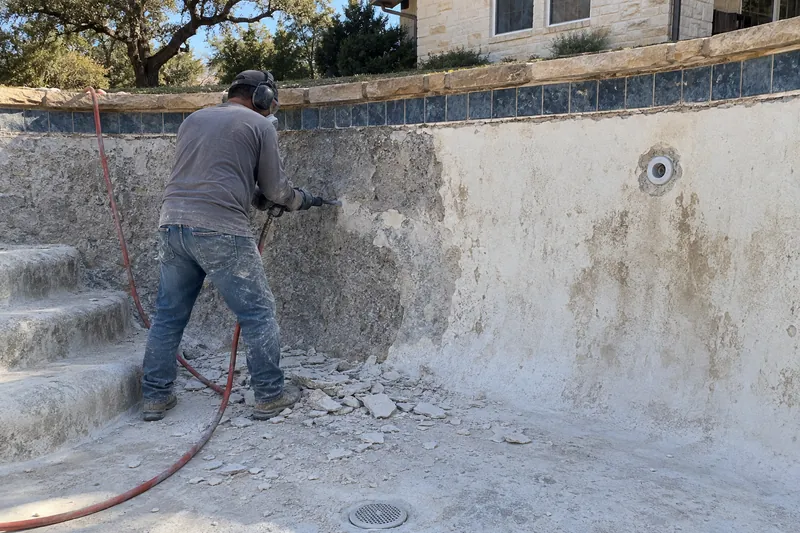
White and colored pool plaster
White plaster is the classic pool look. Some additives, called pozzolans, help it last: the National Plasterers Council says they lock up plaster's weakest element and have been proven to reduce etching, cracking and mottling. They raise the cost, though, and they aren't fool-proof.
What colored plaster does over time
Colored plaster shows every trait of white plaster more strongly, the council says. Expect more mottling, possible pigment streaks, more visible fine surface cracks (crazing), and color that may fade or lighten. None of that counts as a product defect. Sunlight isn't the main cause of fading: most color loss comes from a poor start-up or poorly kept water. Water left aggressive can pull pigment out up to 1/8 inch deep, and that loss can't be undone. Limestone cement, now an estimated 40% of the U.S. market, can also mute colors. One finish maker doesn't warrant colored plaster for color at all.
Weighing quartz instead? The council rates quartz finishes a 10 to 15 year surface, and our quartz pool finishes page covers them. Half of Kirby's homes date from 1978 or earlier, and New Braunfels Quality Pool Resurfacing handles pool replastering in Kirby too.
Call or request a free estimate any time, 24/7.
(830) 302-4112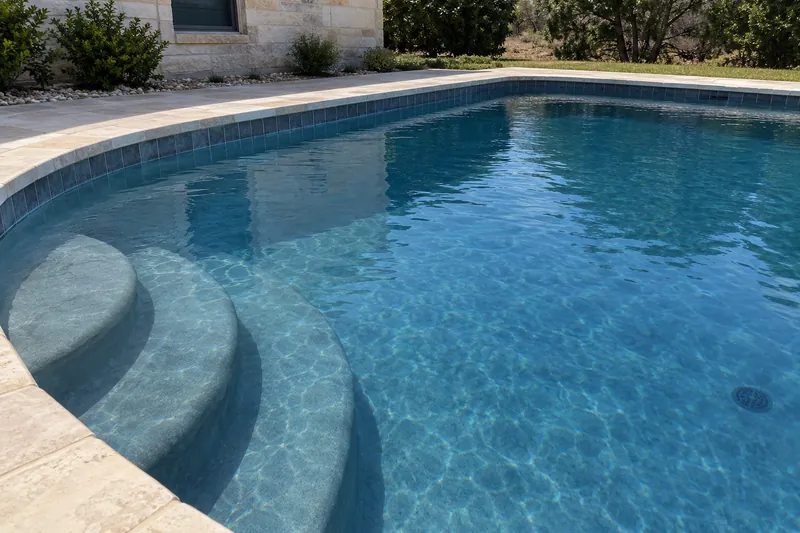
Replastering cost in New Braunfels
Typical New Braunfels prices for replastering run $4,000 to $7,000 on one local price list, as of October 2026. A second local list, also as of October 2026, says $5,000 to $10,000. The 2025 national average for replastering is $6,000 to $8,000. Typical 2026 Texas prices for colored or upgraded plaster run $6,000 to $8,500. Surface area, crack repair and the plaster you choose move the price, and extra chip-out prep adds $1,000 to $3,000 on typical 2026 Texas figures.
Refill water is billed at New Braunfels Utilities' tiered household rates for fiscal year 2027. Some contractors include it in their price and others don't, so ask. Read those as market figures rather than a quote from New Braunfels Quality Pool Resurfacing; the estimate itself is free. The full local breakdown is in the pool resurfacing cost in New Braunfels guide.
- Under 400 sq ft of surface
- $3,500–$5,000
- 400–600 sq ft
- $5,000–$7,000
- 600+ sq ft
- $7,000–$10,000
Typical San Antonio-area prices, 2026, by inside surface area. Averages, not a quote.
Call or request a free estimate any time, 24/7.
(830) 302-4112Pool plaster questions homeowners ask
How often should a pool be replastered?
On the National Plasterers Council's figures, traditional white plaster gives a 5 to 8 year surface, but plaster that's well looked after can last up to 20 years. Care makes the difference. Unbalanced water is the leading cause of a finish wearing out, the council says. Keeping etching down takes good materials, good application, a good start-up and proper care afterward, all together.
Can you repair plaster in a pool?
Yes, for limited damage. One finish maker's method finds hollow spots by tapping, then saw-cuts 3 inches around each bad area and removes the plaster inside. Minor shrinkage cracks may become hard to see once the pool is full and the plaster stays under water, it says. For worse ones, cuts about 3/4 inch deep go on each side of the crack, the plaster between comes out, and the gap is refilled with matching finish. Don't expect a patch to match in color: the same maker says that's nearly impossible. Whether a patch will do on your pool is something New Braunfels Quality Pool Resurfacing checks at the free estimate.
Can you plaster over existing pool plaster?
Yes, with a bond coat, a layer that helps new plaster grip the old. One maker requires its own bond coat when plastering over an existing finish. It cures at least six hours, and the plaster should go on within three to five days. That maker won't warrant its plaster over any other bonding product, and another calls its bonding agent absolutely mandatory on pool renovations. Trade guidance adds that a bond-coat job still needs some chipping out. A pool with more than one layer of plaster, or a lot of loose finish, is a case for chipping it all out.
What color pool plaster is best?
That depends on the water color you want. The finish color decides the water color more than anything else, according to CL Industries, a finish maker. White, blue, black and gray finishes give blue water; green, brown and tan give green. Darker colors tend to hold warmth, and lighter pools stay cooler. White also avoids the extra mottling and fading that colored plaster shows. And no pool finish is guaranteed to be even in color, says a standard finish disclosure that the industry's plastering council endorses.
Can I plaster a pool myself?
The city lets you do construction work on your own homestead if you aren't remodeling it to sell within twelve months. You still need any required permits and must pay the fees. The city is silent on whether replastering alone needs a permit; that's a question for its Development Services office. A pool finish is a special cement mix, put on and finished in one single application. And makers tie warranties to trained hands: one finish maker's 10-year warranty holds only with a factory-approved applicator.
Get a free estimate for replastering or plaster repair
New Braunfels Quality Pool Resurfacing answers calls and estimate requests 24/7 for replastering and plaster repair in New Braunfels and nearby towns. Tell us the pool's size and what the plaster looks like now.