Spa Resurfacing in New Braunfels, TX
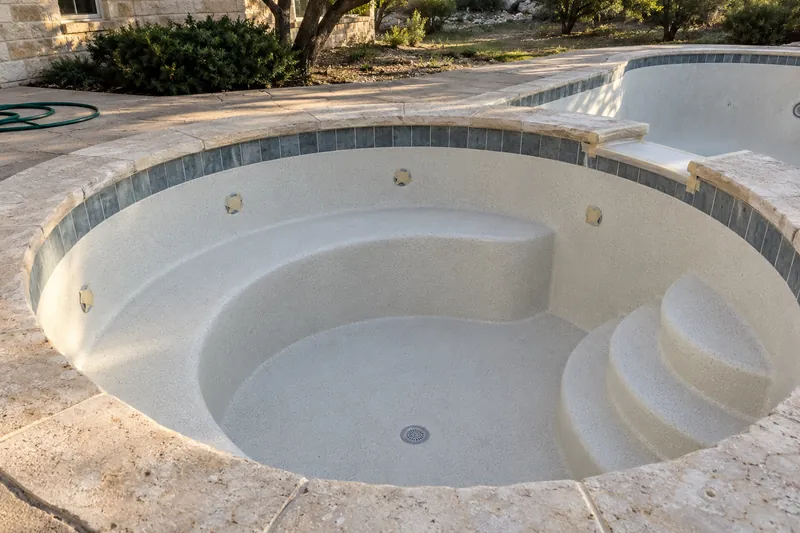
New Braunfels Quality Pool Resurfacing handles spa resurfacing in New Braunfels, Texas, for concrete spas built with a pool or on their own. A spa takes the same kind of cement finish as a pool. The city's pool code, the 2021 International Swimming Pool and Spa Code, holds the plastering of permanently installed concrete spas to the same national standard as pools.
A spa estimate is free; call or send the form. We'll talk through the finish, how long the heater has to stay off afterward, and the city's drain rule, which covers hot tubs as well as pools.
Call or request a free estimate any time, 24/7
No charge · answered 24/7
Get free estimates
Spa resurfacing finishes and the plastering standard
Cement finishes in a spa
The plastering industry recognizes four families of cement finish: white plaster, quartz, pebble and polished. Any of them can give years of reliable service in a well-built, well-kept pool or spa, the National Plasterers Council says. The 2024 edition of the model pool code adds that surfaces people touch mustn't cut, pinch, puncture or scrape them in normal use.
Polished finishes ask for extra work in a spa. One maker's instructions say high-contact areas such as spas and swim-outs may need a second polishing pass with a 120-grit diamond disk.
Glass bead in hot water
Glass bead finishes are rated for heat too. The specification sheet for Beadcrete, a glass bead finish made in Australia, lists it as suitable for water up to 55°C in spa and hot-spring use. It's an Australian document, though, not a set of U.S. warranty terms.
Spa tile and the new finish together
In a remodel, the finish and the waterline tile are usually done at the same time, a finish maker notes. Our pool tile replacement page covers the tile side of the job.
Call or request a free estimate any time, 24/7.
(830) 302-4112Spa water temperature, hard water and scale
How hot the pool code lets spa water get
A water-test maker's default, when the real temperature isn't known, is 76°F for a pool and 104°F for a spa. The 2024 edition of the International Swimming Pool and Spa Code caps the water entering a spa at 104°F, and the water at the heater's return outlet at 140°F. Its spa signs tell people not to get in above 104°F. The city enforces the 2021 edition, so put any code question to its Development Services office.
Heat and the water balance
The National Plasterers Council counts temperature as one of five factors in water balance, along with pH, alkalinity, calcium hardness and dissolved solids. In most cases, it notes, temperature isn't one an owner can control.
The council's saturation index is a single number that says whether water will leave scale or eat into a finish. Its chart gives water at 105°F a temperature factor of 0.9, against 0.6 at 76°F. A higher index means more pull toward scale, so the same water behaves differently in a hot spa than in the pool beside it.
Heat also draws scale out of hard water: the U.S. Geological Survey notes that heated hard water leaves solid calcium carbonate behind. Local groundwater carries extra calcium and magnesium, the city's water utility says.
Call or request a free estimate any time, 24/7.
(830) 302-4112
Spa start-up and the 28-day heater rule
The city's water code counts hot tubs as swimming pools, so its drought plan's drain limits cover a spa too. Resurfacing isn't one of the plan's reasons to drain, so check with New Braunfels Utilities before the spa is emptied.
The National Plasterers Council's filling tips keep the heater off for 28 days after a new cement finish goes in. Not every maker agrees. PebbleTec's maker sets at least 14 days for its own finishes, and a pool industry fact sheet tells owners to follow their finish maker, normally 2 to 4 weeks. Those first 28 days are when a fresh finish is most open to staining, scaling and discoloration, the council's start-up card says.
The plastering itself, from prep to the fill, is covered on our pool replastering page.
Call or request a free estimate any time, 24/7.
(830) 302-4112Spa resurfacing cost
Spa shells cost more per square foot to resurface than pools, on 2026 national figures from one source. The same source puts replastering a pool with an attached spa or wading area at $8,000 to $20,000 for most homes, against roughly $5,500 to $12,000 for a pool alone.
There's no published Texas price for spa work, and none for resurfacing a spa on its own. A spa's real price takes a look at the spa itself, and the estimate from New Braunfels Quality Pool Resurfacing is free.
- White plaster: pool / spa
- $5–$8 / $12–$18
- Quartz: pool / spa
- $10–$14 / $15–$22
- Pebble or aggregate: pool / spa
- $14–$20 / $18–$28
National figures, 2026, from one source. Averages, not a quote.
Call or request a free estimate any time, 24/7.
(830) 302-4112Spa resurfacing questions
Can a gunite spa be resurfaced?
Yes. Gunite is concrete sprayed through a hose at high speed onto a reinforced surface, and it's typical of home pools built below ground. The model pool code holds the plastering of permanently installed concrete spas to the national plastering standard, just as it does for pools. The finish isn't part of the structure, the plastering council notes. Its test, written for pools, is that resurfacing becomes necessary once cracks and wear can no longer be patched, or the surface no longer looks acceptable.
Does hot water wear out a spa finish faster?
No finish maker or plastering standard puts a figure on it. What heat does change is the water balance. On the council's saturation chart, water at 105°F has a temperature factor of 0.9, against 0.6 at 76°F. So the same water leans further toward scale in a spa than in the pool. Paint makers are warier still, and limit or rule out paint in hot tubs.
Can a spa be painted instead of plastered?
Paint makers are cautious about it. One makes a high-build epoxy for spas and hot tubs but rules its acrylic and rubber paints out of them. Another advises against painting spas or hot tubs at all, because the water stays hot for long stretches.
Why does a spa cost more per square foot than a pool?
Spas take more labor. A San Antonio contractor lists spas, beach entries and complex shapes among the features that do. On 2026 national figures from one source, attached spa shells cost $15 to $25 a square foot to replaster, against $8 to $18 for the main pool. That source puts a typical attached spa at 40 to 80 square feet of shell.
Do hotel and HOA spas follow different rules?
Yes. Spas at hotels, apartments and homeowners associations (HOAs) come under the state's public pool and spa rules. Texas sets calcium hardness for public spas at a minimum of 100 parts per million, ideally 150 to 400, and no more than 800. The water's balance, for example by the saturation index, must be tested at least once every 10 days while the spa is open.
Book a free estimate for spa resurfacing
Calls and estimate requests about spas reach New Braunfels Quality Pool Resurfacing around the clock, from New Braunfels and the towns nearby. Tell us whether the spa is attached to a pool and what finish it has now.