Pebble Pool Finishes in Timberwood Park, Texas
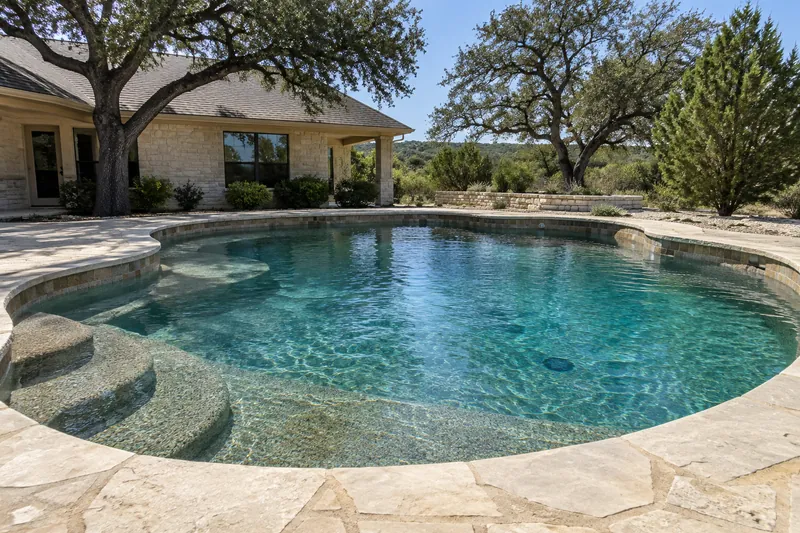
New Braunfels Quality Pool Resurfacing installs pebble pool finishes in Timberwood Park, Texas. A pebble finish is a cement coat packed with small stones. It is sprayed onto the pool shell, pressed down by hand, then rinsed so the stones show at the surface. Timberwood Park's homes sit between U.S. Highway 281 and Blanco Road in north-central Bexar County, around a community park with a seven-acre lake.
The line is open 24/7 for free estimates. We'll talk through stone size and color, how hard water treats a pebble surface, and the San Antonio water rules that limit when a pool may be drained.
Call or request a free estimate any time, 24/7
No charge · answered 24/7
Get free estimates
From Mecke Ranch to half-acre lots
Timberwood Park is a suburban community about twenty miles north of San Antonio. It is a Census-designated place, not a city. Its story goes back to 1848, when Johann Theodor Gerfers bought the first 160 acres here to raise cattle and sheep. In 1889 his family sold more than 2,000 acres to Richard A. Mecke, who renamed the land the Mecke Ranch. The Timberwood Development Company bought the northern tract in December 1976 and the southern tract in November 1979.
The development covers 2,172 acres, the seventh-largest subdivision in Bexar County in 2017. It holds 3,263 lots, most of them half an acre, and its park adds a six-hole golf course and a swimming pool to the lake. Gerfers Cemetery, with burials from 1873 to 1922, is now a state-designated Texas Historic Cemetery. Growth came quickly: 2,578 residents in 1990, 5,889 in 2000 and 13,447 in 2010, then 35,217 at the 2020 Census.
Newer homes, higher values
Most homes here are recent. Their median build year is 2008 in the Census Bureau's 2020–2024 survey, with 43.0 percent built from 2000 to 2009 and 33.3 percent from 2010 to 2019. About 85.9 percent are owner-occupied, and the median owner's home is valued at $510,600. Still, a pool can be added years after the house is built, so the surface itself is what to judge.
Pebble sits at the top of the cement finishes. The National Plasterers Council rates pebble a 12 to 18 year surface and calls it an upgraded cost option. Typical San Antonio-area prices from 2025 put a pebble finish at $7,000 to $12,000 for a standard pool with 400 to 600 square feet of surface. They are published averages, not prices of ours, and pricing your own pool costs nothing.
Call or request a free estimate any time, 24/7.
(830) 302-4112Who rules on pool work outside city limits
With no city government, Timberwood Park falls under Bexar County, and the county's rules are light. It has no zoning in its unincorporated areas. It requires a building permit for commercial, publicly accessible and multi-family buildings. For a private home, the county reviews plans and issues a permit only when the owner applies voluntarily, for example because an owners' association or a lender asks for one.
When a permit is sought, the county works from the 2021 International Code Series with its own amendments. The Bexar County Fire Marshal's Office handles it, after a Building Permit Authorization from Bexar County Public Works. The county's published guidance doesn't mention pool resurfacing. So before work starts, read any deed restrictions or owners' association rules that cover your lot.
Call or request a free estimate any time, 24/7.
(830) 302-4112Hard water and a pebble surface
Timberwood Park's water history runs through the San Antonio Water System (SAWS). A list of water suppliers that SAWS posted in 2019 names the Bexar Metropolitan Water District's Timberwood Park system, at Timberline Drive and Borgfeld Road. In November 2011 the district's ratepayers voted to dissolve it into SAWS, and federal approval followed in late January 2012. Your water bill shows who supplies your home today.
For its own water, SAWS gives a typical hardness of 15 to 20 grains per gallon. Hardness means the calcium and magnesium in the water, and SAWS says it occurs naturally in Edwards and Trinity aquifer water. Its yearly water quality report leaves calcium out and points readers to state records for those results.
What scale does to the stones
Every surface that sits in pool water can collect mineral scale, cement, tile and glass included, the plastering industry says. It looks like a white or light film, and it can mute the finish color or hide it completely. Pebble still has an edge. One pebble maker says its process leaves the hardest part of the finish, the natural stone, at the water's surface. There, it resists staining, etching and wear better than plaster or quartz.
Balanced water keeps scale in check. The National Plasterers Council's ideal range for the saturation index, a measure of whether water will deposit scale or attack the surface, is 0.0 to +0.3. After the first 28 days, PebbleTec's maker suggests keeping the water to the council's standards. Brushing helps too: pool chemicals are heavier than water, and if they settle on the finish they can etch or discolor it, a finish maker warns.
Call or request a free estimate any time, 24/7.
(830) 302-4112Cobbly clay over hard rock
Timberwood Park sits on Edwards Plateau ground. The U.S. Department of Agriculture's soil survey maps Eckrant cobbly clay as its largest soil, followed by the Brackett-Eckrant association on slopes of 20 to 60 percent and Eckrant very cobbly clay. Eckrant lies over hard bedrock, typically at 28 cm. Shallow digging in it is very limited, the survey says, because of that rock and its large stones. Driveways and sidewalks get the same rating, with shrink-swell added to the reasons.
A pebble resurfacing works inside the existing shell, so it doesn't dig into that rock. The ground still counts once the pool is empty. Draining any pool carries risk, a pool maker warns. Once the water is low, groundwater pressure can make a shell bulge, crack or even float. Of all soils, clay lets that water drain away most slowly, the same maker says, and Eckrant is a clay. Plan the drain with care, and keep the time the shell stands empty short.
Call or request a free estimate any time, 24/7.
(830) 302-4112San Antonio's pool-draining rule
SAWS now bills a water-waste charge instead of writing citations, and it says that makes its drought rules apply to all its customers, not only those inside San Antonio. The city's drought ordinance itself covers San Antonio and its extraterritorial jurisdiction (the zone just outside its limits) where SAWS provides service. Published sources don't say whether Timberwood Park lies in that zone.
From Stage 2 on, San Antonio's rule sends drained water only to ground that can absorb it, either directly or across a deck that empties onto that ground. And it allows a drain only to:
- bring the level down after rain;
- fix, maintain or replace a hazardous pool part;
- repair a leak.
A public pool may be refilled only after a drain for one of the last two reasons. Resurfacing isn't on the list, and nothing official says whether it counts. Ask SAWS before the pool is emptied.
Stages, and San Antonio's year-round pool rules
SAWS sets its stages by the Edwards Aquifer's level at a monitored well, as a 10-day rolling average. Stage 1 begins at 660 feet, Stage 2 at 650 feet and Stage 3 at 640 feet, and the City Manager may declare Stage 4. On October 6, 2026, the Edwards Aquifer Authority showed its J-17 well at 640.8 feet. That is the authority's reading, not a SAWS stage notice, so check the stage with SAWS when you plan the work.
Since May 1, 2013, San Antonio's code has also set year-round rules for pool construction. Automatic fill devices must shut themselves off, and every home pool needs a hose-end timer at the nearest hose bib. Pool companies must give customers written care instructions that stress alternatives to draining, unless a drain is needed for physical repair. That part of the code doesn't say whether these rules reach homes outside the city limits.
Call or request a free estimate any time, 24/7.
(830) 302-4112Beyond the pebble finish
A new finish is a natural time to look at the rest of the pool: worn waterline tile, loose coping, a cracked deck or a slow leak. We also replaster and apply quartz and glass bead finishes. Textures, start-up and the makers' warranties are set out on the pebble pool finishes page. Up U.S. 281 in Comal County, New Braunfels Quality Pool Resurfacing also applies glass bead pool finishes in Bulverde.
Call or request a free estimate any time, 24/7.
(830) 302-4112How a pebble resurfacing runs
The usual trade sequence, plus the water checks this area needs.
Stone and color samples
We look at the pool, measure its surface and talk through stone size and color samples. The estimate is free, and nothing is booked until you decide.
Check the water rules
Before a date is set, confirm with your water supplier which drought stage applies and whether the drain is allowed.
Strip the old surface
The old finish is taken off so the new one bonds to a clean, even base.
Pump, press and rinse
The stone mix is pumped on, pressed down by hand, then rinsed or wiped until the stones show. A hardening period follows, then a pressure wash and an acid rinse clear away the film.
Fill in one go
One pebble line's spec calls for cleanup the day after it goes on, then a single, unbroken fill until every bit of the finish is submerged.
The first 28 days
A new finish takes about 28 days to cure for the most part, one finish maker says. In that time, PebbleTec's maker says adding acid daily for two weeks, then two or three times a week, is not unusual.
Price a pebble finish for a half-acre lot pool
Phone or form requests from across Timberwood Park and north-central Bexar County get to New Braunfels Quality Pool Resurfacing 24/7. Mention how big the pool is and what finish is on it today.